
Straight fan swap
$150 – $300
Fan-rated box already in place, existing switch, standard eight-foot ceiling. Same range as a simple fixture swap.
New fans, replacements, and the fan-rated box most ceilings actually need first. Sloped and vaulted mounts, downrod sizing, wobble fixed, separate fan and light control.
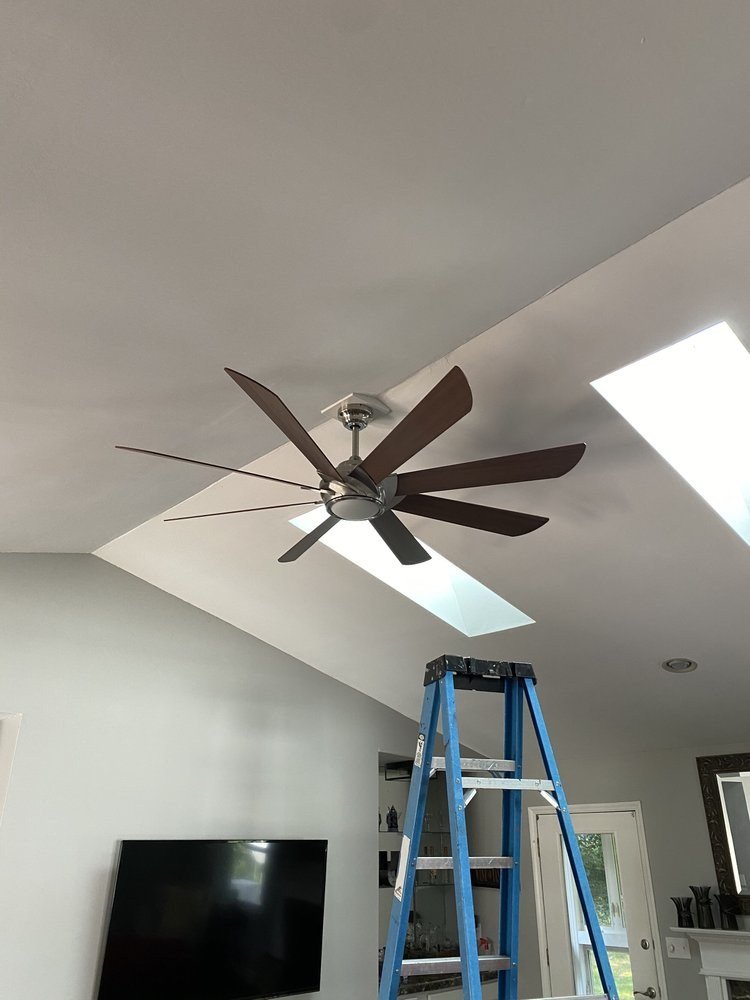
Hanging a ceiling fan looks like a one-hour job until you get the old fixture down and find out what's actually in the ceiling. The box that held a five-pound light is not built to hold a thirty-pound fan that spins, and in most Asheville homes it isn't rated for one.
That's the part homeowners don't see coming, and it's the part that matters. A fan hung off a standard fixture box can work loose over months of vibration. Code is specific about it: the box has to be listed and marked for fan support. We replace it, brace it to the framing, and then hang the fan.
We do these constantly — swaps, first-time installs, vaulted great rooms, covered porches, and fans that have wobbled since the day somebody else put them up. No minimum job, so a single fan is a perfectly normal call.
None of these are dealbreakers. They're just the things that decide whether it's an hour or an afternoon — and we'd rather you hear them now than at the quote.
The box isn't fan-rated. The most common one by a wide margin. A standard fixture box is fine for a light, but code requires that any box carrying a ceiling fan be listed and marked for fan support — that's a different box, not just a stronger one. A fan-rated box handles fans up to 70 pounds when it's marked for the weight; above 35 pounds the marking has to state the maximum. Swapping it means opening a small area of ceiling and bracing to joists — routine, but it's real work.
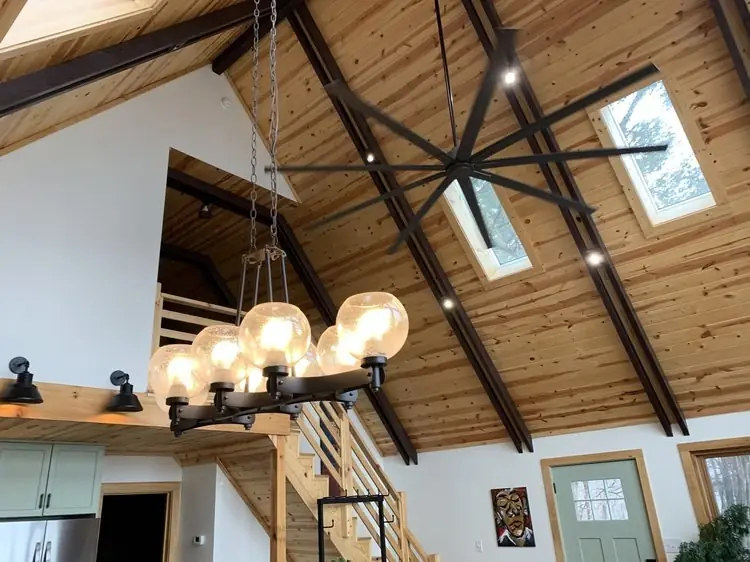
The ceiling is sloped or vaulted. Asheville has a lot of A-frames, converted attics, and great rooms with serious pitch. Those need a canopy rated for the angle and a downrod long enough to bring the blades clear of the slope and down into the room where they'll actually move air.
You want the light and fan on separate switches. If there's one switched conductor in that box, separating them means either pulling new wire to the switch or going with a remote or wall control that splits the signal over what's already there.
There's no ceiling box at all. Adding a fan where none has ever hung means running a circuit and putting in a switch. That's a bigger job and priced accordingly, but it's very doable in most homes.
The old fan wobbles. Worth diagnosing rather than replacing on reflex. Often it's the mount, not the fan.
We kill the circuit and verify it's dead at the box before anything comes down — not at the breaker label, at the box. Old fixture or fan comes out, and we look at what's holding it. If the box is fan-rated and solid, we're straight into mounting. If it isn't, we tell you right then what the change costs before we do it.
The bracket goes up, the downrod gets sized to your ceiling height and pitch, and the fan goes together on the ground where it's safe to do rather than overhead. Wiring gets landed, the canopy closes up, and we run it through every speed and both directions looking for wobble. If there's any, it gets balanced before we leave.
Then we clean up. A typical single-fan swap is an hour or two. Add a box replacement or a new circuit and it's a half day.
We quote before we start, and the quote is the price. No minimum job.
$150 – $300
Fan-rated box already in place, existing switch, standard eight-foot ceiling. Same range as a simple fixture swap.
$250 – $450
The most common real-world version. Replacing a non-rated box and bracing it to the framing before the fan goes up.
$400 – $900
Sloped-ceiling mount and sized downrod, tall-ladder work in a great room, or a fan where no box and no circuit exist yet.
Typical ranges, not your quote. We price your specific ceiling before we start — no minimum job.
A straightforward swap — fan-rated box already in place, existing switch, standard eight-foot ceiling — runs in the same range as a simple fixture swap, roughly $150 to $300. From there the number moves on a few specific things: replacing the box for one that's fan-rated, the downrod and sloped mount for a vaulted ceiling, running a new conductor if you want the light switched separately, and ceiling height, because a great room means working off a tall ladder rather than a step stool.
Adding a fan where there's no box and no circuit is a different job — new wire, new switch — and we'll price that on what we find. If you've got several fans going in at once, say so when you call. Doing them in one visit is cheaper per fan than doing them one at a time.
Usually yes, but the box has to change. This isn't really about weight — code is stricter than that. Any box used as the sole support of a ceiling fan has to be listed and marked for fan support, full stop, even for a light fan. A standard fixture box isn't, and it isn't built for the twisting load a spinning fan puts on it. Most existing boxes in Asheville homes are plain fixture boxes, so we replace the box with a fan-rated one, braced to the framing, before the fan goes up.
A straightforward swap — fan-rated box already there, existing switch, normal ceiling height — lands in the same range as a simple fixture swap, roughly $150-$300. It goes up when we have to replace the box, add a downrod for a vaulted ceiling, run new wire for a separate light switch, or work off a tall ladder in a great room. We quote before we start, and there's no minimum job.
North Carolina draws the line at who's getting paid. State law (G.S. 87-43.1(5a)) lets you do electrical work on your own property, for your own benefit, as long as it isn't a property you're renting out or intending to sell. That exemption covers you — it does not cover someone you hire. Paid electrical work on your home has to be done by a licensed electrical contractor, handyman or not. The practical reason it matters here: if the box isn't fan-rated, this stops being a fixture swap and becomes structural work over your head.
Almost always. Wobble is usually one of three things: a box that isn't rigid enough, a bent blade or blade arm, or blades that aren't weight-matched. We check the mount first, because a loose box is the one that actually matters for safety. Balancing kits fix the rest. A fan that has wobbled for years can loosen its own mounting screws, so it's worth looking at.
Yes. Sloped ceilings need a mount rated for the pitch and usually a downrod long enough to clear the slope and keep the blades level. A lot of Asheville great rooms and A-frames run steeper than a standard canopy will handle, so we size the downrod to the actual pitch and ceiling height rather than guessing.
Yes, and it's the most common upgrade people ask for once the fan is up. If there's only one switched wire in the box today, that means either running a new conductor to the switch, or using a fan with a remote or a wall control that separates the two over the existing wiring. We'll tell you which is cheaper for your specific ceiling.
Yes — but the fan has to be rated for it. A covered porch needs a damp-rated fan; anything exposed to blowing rain needs a wet-rated one. Indoor fans on Asheville porches rust out at the bearings and the blades warp. If you already bought an indoor fan for a porch, we'll tell you before we hang it.
Most people buy their own — fan choice is aesthetic and you should get the one you actually want. Bring it home, we handle the wiring, the box, the mount, and the balance. If you'd rather we source it, we can, but you'll usually do better picking it yourself.
Real photos from our own jobs around Asheville. No stock photos.
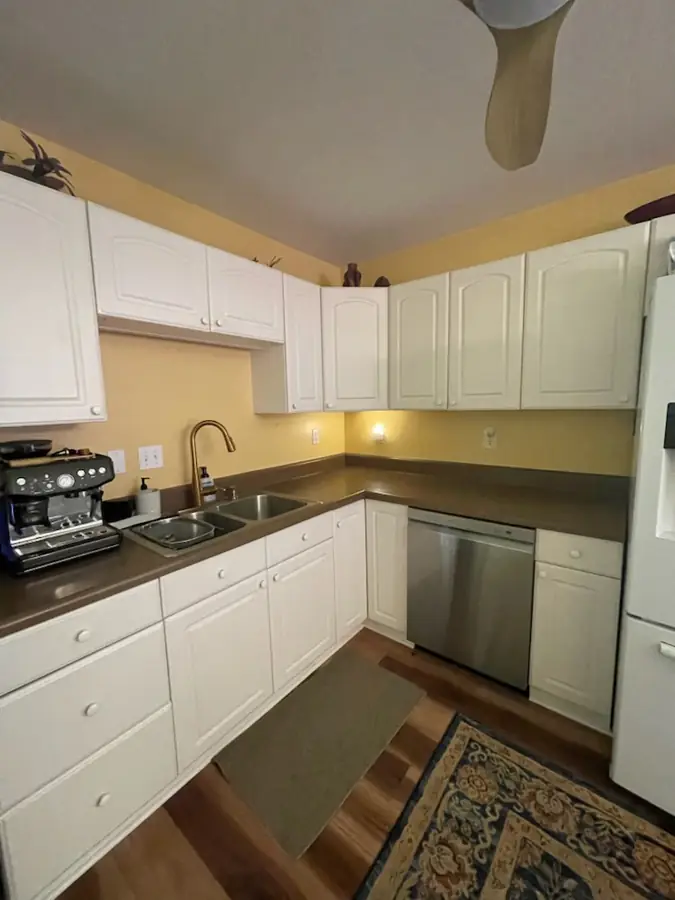
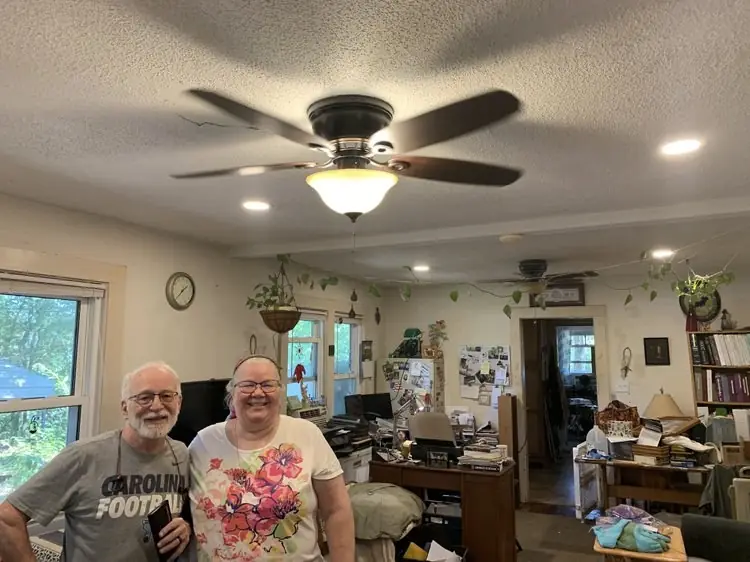
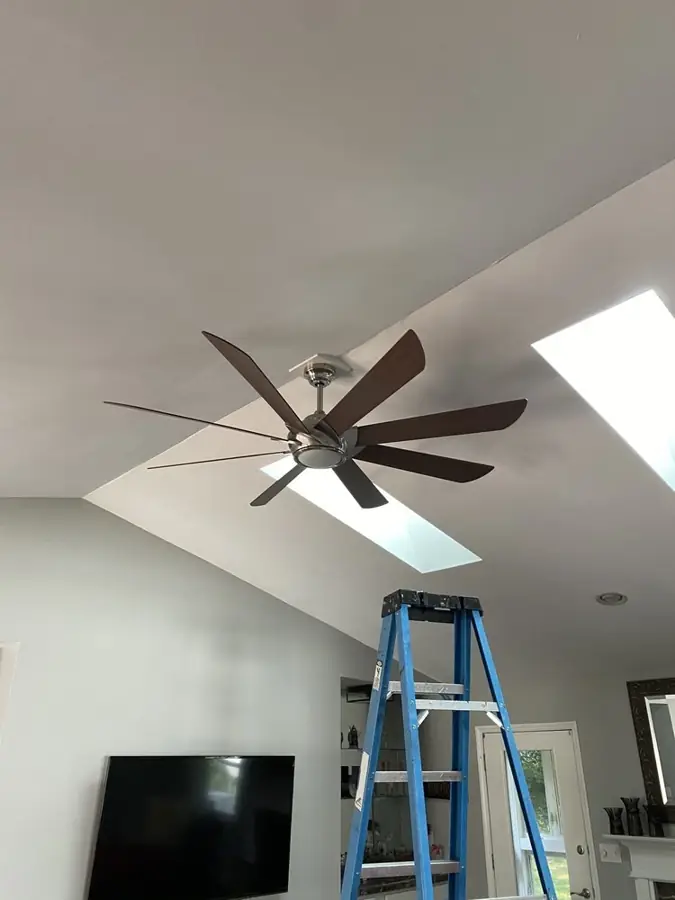
We answer calls 7 days a week, 5 AM to 11:30 PM. A real person, not a phone tree or call center.
(828) 551-9843 Call now · Free estimate (828) 551-9843