Electrical service · Asheville, NC

Whole-House Rewiring in Asheville

Older Asheville homes with mixed wiring — knob & tube, BX, old Romex. Renovation rewires. Plain-English quotes. Permits pulled, inspection scheduled. Lifetime workmanship warranty.

★ 4.8 stars · 163 Google reviews · NCBELC #33298 · Insured · Lifetime workmanship warranty · No minimum job
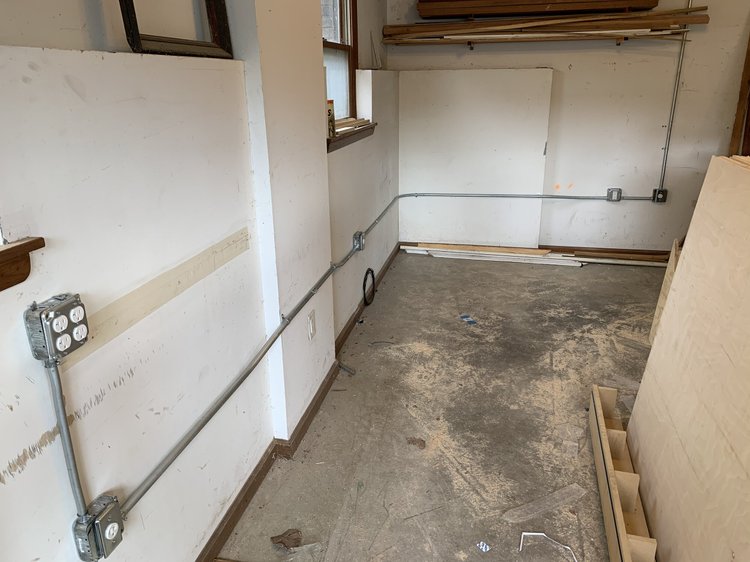
Mid-rewire rough-in inside an Asheville home — fresh metal conduit run with new outlet boxes mounted along the walls
Recent Asheville rewire rough-in — Power to the People

Most Asheville homes built before 1970 have three different wiring eras running in parallel: original knob and tube in the attic and exterior walls, BX (armored cable) added during 1950s-60s renovations, and modern Romex from later updates. Each works. None of them work well together.

A whole-house rewire pulls all of it out and replaces everything with current-code grounded copper. It's a bigger job than a knob-and-tube-only rewire, but for homes with this kind of mixed lineage, it's usually cleaner than three phased projects.

Below: when whole-house makes sense vs. targeted rewiring, what 1-3 weeks on-site actually looks like, and how we minimize damage to plaster walls.

What we replace

Five problem wiring types in Asheville homes.

The three eras above (K&T, BX, old Romex) cover most pre-1970 homes. Two more wiring types show up often enough to call out separately — aluminum branch wiring from the early 70s, and ungrounded 2-wire systems.

Knob & tube (pre-1950)

Open conductors threaded through porcelain knobs and tubes. Ungrounded, brittle insulation, can't handle modern loads. Insurance carriers commonly won't cover homes with active K&T. For the deep dive on pre-1950 K&T removal in historic Asheville homes, see the dedicated page.

BX armored cable (1950s-60s)

Spiral metal sheath over cloth-insulated conductors. The metal jacket was supposed to be the ground path, but the bonding fails with age. Common in 1950s-60s Asheville renovations layered on top of original K&T.

Old Romex with cloth insulation

1950s-60s cloth/rubber-sheathed cable. Insulation degrades and goes brittle when disturbed; often ungrounded. Distinguishable from modern (post-1970) plastic-sheathed Romex by the cloth texture.

Aluminum branch wiring (late 60s / early 70s)

Aluminum was substituted for copper during a 1960s–70s copper-price spike. Of the older wiring types on this page, it's the one we treat as the most urgent fire risk — even ahead of knob & tube — because the hazard is active and ongoing at every connection. Aluminum expands, contracts, and slowly creeps under heat more than copper does, and it oxidizes; over the years that loosens connections at outlets, switches, and panel terminations and raises their resistance. A high-resistance connection runs hot, and an overheating or arcing connection is a serious fire hazard. The U.S. Consumer Product Safety Commission found that homes built before 1972 and wired with aluminum branch circuits were 55 times more likely to have one or more outlet connections reach "fire-hazard conditions" than homes wired with copper.

The concern is specific to the small-gauge solid aluminum on 15- and 20-amp branch circuits (the runs feeding your outlets and lights) — not the larger-gauge aluminum used for service entrances, feeders, and dedicated range/dryer circuits, which the CPSC's branch-wiring guidance explicitly excludes. The CPSC flagged aluminum branch wiring decades ago: these homes carry significantly higher fire risk, and some insurers require an inspection or remediation before they'll write or renew coverage. CPSC-recognized permanent repairs are a full copper replacement, or COPALUM / AlumiConn connectors installed by a qualified electrician at every aluminum connection. What we usually find in the field is older "repairs" that were incomplete or used methods the CPSC doesn't recommend — so a full rewire to copper is the cleanest, most durable fix.

Ungrounded 2-wire systems

Pre-1960s wiring that ran hot + neutral only — no ground. Not as urgent as K&T or aluminum (insulation can be sound, no specific fire mechanism), but some homeowners elect to rewire anyway. Reason: every grounded modern appliance, surge protector, and three-prong device needs a real ground to actually do its job. Often paired with a remodel rather than done as a standalone job.

When it makes sense

Whole-house, targeted, or wait?

Go whole-house if…

  • Multiple wiring eras visible (K&T + BX + old Romex)
  • Insurance issued a full-removal letter
  • Major renovation already opening most walls
  • Selling and inspector flagged systemic issues
  • Repeated electrical issues across multiple circuits

Go targeted if…

  • Only one wiring era is problematic (often K&T-only)
  • Specific circuits are failing but rest is sound
  • Budget requires phasing the work
  • You're staying in the home and can do K&T now, panel next year, kitchen rewire when remodeling

Wait if…

  • Wiring is older but inspection shows it's stable
  • No insurance pressure
  • You're planning a major renovation in 12-18 months that will open the walls anyway
  • Selling within a year and price-impact math says skip

We're happy to inspect first and tell you which of these you're in. Free for realtor referrals; small fee otherwise that we credit toward the job if you book.

What 1-3 weeks looks like

Phased work, room by room.

You stay in the house. Power stays on for most of the job. Here's how we structure it.

  1. Days 1-2: Mapping + access.

    We walk every room, identify circuit boundaries, locate junction boxes and existing splices. We cut clean access points where we need them — typically 4-6 per room in plaster, fewer in drywall. Plaster takes longer; we pad the schedule for it.

  2. Days 3-7 (1,400-2,200 sqft): Pull and replace.

    Phased by zone. We typically work the upstairs bedrooms first (least disruptive to daily living), then kitchen, then living areas, then primary bedroom last. Power off only in the active zone — rest of the house stays live. Most days end with everything in your living areas working.

  3. Days 5-10: Panel + service tie-in.

    If we're upgrading the panel as part of the rewire (most jobs), this is where Duke Energy schedules the service drop and we tie everything in. Power off for 4-6 hours during the swap.

  4. Final day: Trim-out + walkthrough.

    New outlets and switches installed and labeled, smoke/CO detectors verified, GFCI/AFCI tested. We walk the house with you, show you the new panel layout, hand over the inspection sign-off paperwork. Drywall repair is itemized — we patch or you do.

Common questions

Rewiring questions, answered.

Ready to call your Asheville electrician?

A real person picks up M-F 8am-7pm — not a phone tree, not a call center.

(828) 551-9843 Call now · Free estimate (828) 551-9843
Licensed & insured · Asheville-owned · Lifetime workmanship warranty